Guides › Apostille
How to Get an Apostille in Florida: Step-by-Step Guide
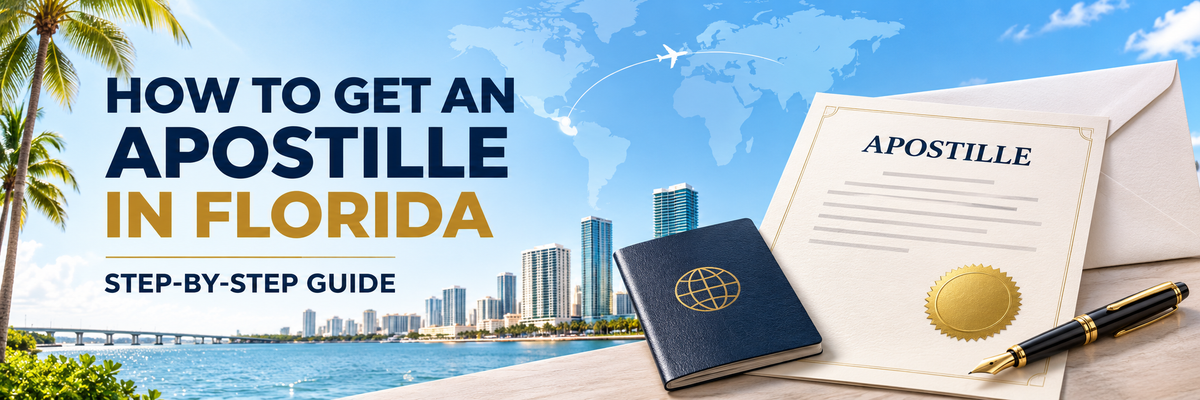
How to Get an Apostille in Florida: Step-by-Step Guide
If a foreign government, school, bank, or court asked you for an "apostilled" document, you're not alone, and it isn't as complicated as it sounds. This guide explains what a Florida apostille is, which documents qualify, what the Florida Department of State requires, and how to avoid the mistakes that get requests sent back.
What is an apostille?
An apostille is a certificate attached to a document so that it is recognized in another country. It confirms that the signature, seal, or stamp on your document is genuine. Apostilles are used for countries that belong to the 1961 Hague Apostille Convention. For countries that are not part of the Convention, Florida issues a notarial certification instead, which is then usually legalized by that country's embassy or consulate.
In Florida, apostilles are issued only by the Florida Department of State, Division of Corporations, in Tallahassee. You can review the state's official apostille and notarial certification instructions.
Which documents can get a Florida apostille?
Florida can only apostille documents that were signed by a Florida notary or a Florida public official. Common examples:
- Notarized documents such as powers of attorney, affidavits, consent-to-travel letters, and declarations, as long as they were notarized by a Florida notary (in person or through remote online notarization).
- Certified copies notarized by a Florida notary, where Florida law allows it.
- Birth, death, and marriage certificates issued by the Florida Bureau of Vital Statistics in Jacksonville and signed by the State Registrar. Copies issued by a local county health department are not accepted for apostille.
- Court documents such as divorce judgments or marriage licenses, certified by a Florida Clerk of Circuit Court.
- Business filings such as certified Articles of Organization or Certificates of Status from the Division of Corporations.
- School transcripts and diplomas from Florida schools and universities, but only if the registrar's signature was notarized when the school issued them. You can't print a transcript yourself and get it notarized.
What Florida cannot apostille
- Federal documents such as FBI background checks or documents signed by a federal agency. These go to the U.S. Department of State.
- Documents from other states. A New York birth certificate, for example, has to be apostilled by New York.
- Photocopies. The state needs the original signature or seal.
Step-by-step: how to get a Florida apostille
- Confirm what the receiving country needs. Ask the person or office requesting the document whether they need an original, a certified copy, or a notarized copy, and whether a translation is also required. Not sure which service you need? See our guide to notarization, apostille, and certified translation.
- Get the right version of the document. That may mean ordering a certified birth certificate from the Bureau of Vital Statistics, a certified court copy from the Clerk, or having a document notarized by a Florida notary.
- Check the notarization. If your document is notarized, the notarial certificate must be complete, with the notary's signature and seal. An incomplete or incorrect notarial certificate is one of the most common reasons for rejection.
- Prepare a cover letter or request form that names the country where the document will be used. The state needs the country to know whether to issue an apostille or a notarial certification.
- Include the state fee. Florida charges $10 per notarized document or vital record and $20 per Clerk-certified court document, payable only by check or money order to the "Department of State."
- Include return shipping, either a self-addressed stamped envelope or a prepaid courier label.
- Mail it and wait. The state processes requests in the order received, says to allow at least five business days plus mailing time, and does not offer expedited service.
Common mistakes that delay an apostille
- Sending a birth certificate from a county health department instead of the state Bureau of Vital Statistics.
- Sending a document from another state, or a federal document, to Florida.
- Leaving out the destination country.
- Paying by credit card or cash, or sending the wrong fee amount.
- An incomplete notarial certificate, or a notary whose commission was not active.
- Forgetting that the receiving country may also need a certified translation.
Can I get a document apostilled if I live outside the United States?
Often, yes. If your document is one you sign yourself, such as a power of attorney or an affidavit, a Florida online notary can notarize it by secure video while you are abroad. Because a Florida notary performed the notarization, the document can then go to the Florida Department of State for an apostille. Whether this works for your document depends on the document type and on what the receiving country accepts, so check with the requesting office first. Learn more in our guide on how to notarize a U.S. document from abroad.
Let us handle it for you
Leones E-Notary Services handles the whole Florida apostille process remotely: we review your document, notarize it online if needed, submit it to the Florida Department of State, and mail the apostilled original back to you anywhere in the U.S. at no extra shipping cost. We also offer certified English–Spanish translations if the receiving country needs one.
Request your Florida apostille, book an online notary session, or contact Leones E-Notary Services with questions.
Frequently asked questions
How much does a Florida apostille cost?
The state fee is $10 per notarized document or vital record and $20 per Clerk-certified court document. Service fees for notarization, handling, and shipping are separate if you use a service.
How long does a Florida apostille take?
The Florida Department of State asks you to allow at least five business days for processing, plus mailing time in both directions. It does not offer expedited processing.
Can a document notarized online be apostilled?
Yes. A document notarized by a Florida online notary can receive a Florida apostille, just like one notarized in person.
Do I need a translation too?
Many countries require documents in their official language. Ask the receiving office whether you need a certified translation, and whether the translation also needs to be notarized or apostilled.
This guide is general information, not legal advice. Requirements can change, and the receiving country or office has the final say on what it accepts.